Production of Kennedy half dollars in 1986 followed standard United States Mint protocols.
Large portions of this mintage entered general circulation or government-issued collector sets.
Historical records confirm a lack of commemorative themes for this specific year.
The current 1986 Half Dollar value indicates sustained growth for specimens maintaining high-grade preservation.
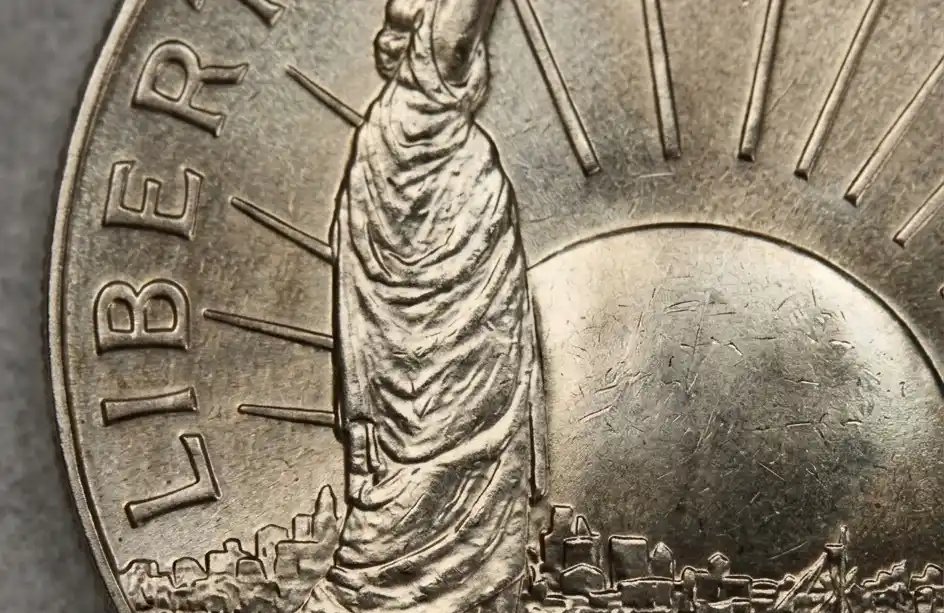
alt: close-up emphasizing texture and wear of 1986 half dollar
Strict adherence to federal minting guidelines ensures uniformity across all issued units.
Constant monitoring of weight and metal composition occurred during the fabrication process.
| Parameter | 1986 Specification |
| Face Value | $0.50 |
| Metal Composition | Copper-Nickel Clad |
| Weight | 11.34 grams |
| Shape | Round |
| Diameter | 30.61 mm |
| Thickness | 2.15 mm |
| Edge Type | Reeded |
Utilizing a copper-nickel cladding layer determines the physical characteristics of the blank.
Alloy hardness directly affects the strike quality of Kennedy’s portrait.
Production Statistics by Mint Facility
Distribution of mintage across different branches reflects the logistical needs of the 1986 financial system.
Each facility employed specific dies bearing corresponding mint marks.
1986 Output Figures:
- Philadelphia (P): 13,107,633 units
- Denver (D): 15,336,145 units
- San Francisco (S): 3,010,497 units
Total production volume exceeded 31 million individual pieces.
San Francisco output consisted exclusively of Proof quality strikes.
Market Value Dynamics 2021–2026
Investment potential for these coins depends entirely on their certified grade.
Statistical evidence reveals annual price shifts for top-tier preservation categories.
Annual Price Growth for MS66 Grade: 2021 → $35 2022 → $38 (+8%) 2023 → $42 (+10%) 2024 → $47 (+12%) 2025 → $54 (+15%) 2026 → $65 (+20%)
Value Depreciation Factors for Lower Grades:
- Transitioning MS67 to MS66: 60% loss in market value
- Transitioning MS66 to MS65: 45% loss in market value
- Visible surface scratches: 80% reduction from market baseline
Rare mint errors bypass general trends, increasing in value regardless of market indices.
Registry of Exceptional Specimens and Records
Locating coins in MS67 condition or higher happens extremely rarely.
Technological constraints during 1986 production often resulted in frequent micro-defects.
Auction Highlights 2024-2026:
- 1986-P MS67 (PCGS): $2,100 (Heritage)
- 1986-D MS67+ (NGC): $3,450 (Stacks Bowers)
- 1986-S PR70DCAM (PCGS): $850 (eBay)
- 1986-P Double Die Strike: $1,200 (Goldberg)
Final hammer prices rely on the absence of contact marks on the focal points.
Maintaining original mint luster significantly increases the probability of record-setting sales.
Wear Mechanics and Relief Preservation
Contact with other metallic objects causes irreversible damage to the soft cladding layer.
Surface degradation follows a predictable sequential path.
Structural Breakdown Chain: Initial Strike → Bag marks during transit → Flattening of hair detail → Metal darkening → Total loss of legend clarity
Employing inert plastic holders effectively slows these chemical processes.
Cleaning a coin chemically destroys the original surface, reducing value by 90%.
Causality of Market Value
Price formation factors divide into technical and market-driven categories.
Interactions between supply and demand determine final market quotations.
Value Appreciation Logic: High Grade → Professional Certification → Increased Auction Competition → Record Price
Depreciation Logic: Circulation in Trade → Mechanical Wear → Loss of Numismatic Status → Face Value Only
Limited investment demand for lower grades restricts their overall liquidity.
Selling circulated specimens remains practical only as part of bulk weight lots.
Comparative Analysis of P and D Dies
Visual execution of mint marks shows variations in letter depth.
Technical reliability of equipment in Denver appeared more stable during 1986.
Philadelphia Strike Indicators:
- Deep relief on LIBERTY lettering
- Frequent edge defects
- Moderate die wear
- Matte field appearance
Denver Strike Indicators:
- High clarity on reverse stars
- Superior mint luster
- Absence of field polishing lines
- Distinct eagle feather separation
Denver strike quality consistently outranks Philadelphia for this specific year.
Superior manufacturing explains the higher survival rate of MS66 specimens from Colorado.
Characteristics of Proof Issues
San Francisco coins targeted specialized annual collector sets.
Minting technology required double strikes with polished dies on polished blanks.
Deep Cameo Category Attributes:
- Mirrored fields lacking any scratches
- Intensely frosted portrait relief
- High image contrast
- Perfect centering
Most Proof coins retained high grades due to protective plastic packaging.
Developing milk spots on the surface drops the category to standard Cameo.
Rarity Factors: Survival of Mintage
Total output volume does not always dictate market scarcity.
Extensive use of coins in gambling machines led to the destruction of original surfaces.
| Coin Type | Total Mintage | MS66+ Survival | 2026 Status |
| 1986-P | 13,107,633 | 0.02% | Rare |
| 1986-D | 15,336,145 | 0.05% | Scarce |
| 1986-S | 3,010,497 | 25% | Common |
Poor survival for Philadelphia coins stems from harsh storage in bank bags.
Denver specimens appear more frequently in bank rolls without circulation damage.
Classification by Die State
Condition of the striking tool affects the sharpness of fine details.
Late-stage strikes from worn dies create metal flow lines on the letters.
Die Wear Markers:
- Blurred IN GOD WE TRUST inscription
- Missing pearls in the eagle’s crown
- Radial lines around the portrait
- Centering shifts
Discovering a mint error can increase coin value by 3 to 5 times.
Specimens featuring double strikes or 180-degree rotations command premium prices.
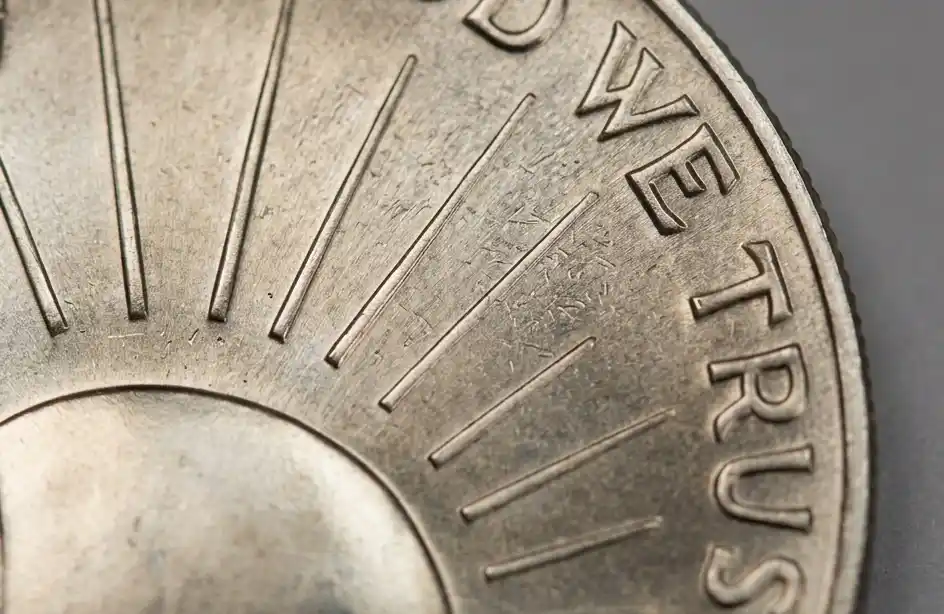
alt: extreme close-up of 1986 Half Dollar surface highlighting engraving details
Investment Risks and Authentication
The 2026 market contains sophisticated copies originating from overseas.
Testing metal density helps exclude the use of unoriginal alloys.
Counterfeit Indicators:
- Mushy relief lacking sharp edges
- Absence of a metallic ring when dropped
- Weight variance exceeding 0.05 grams
- Casting seams visible on the edge
Professional grading in independent labs confirms claimed technical specs.
Expert examination costs between $25 and $120 depending on service speed.
Impact of Toning on Collector Value
Oxidation layers on the copper-nickel surface form over decades.
Rainbow toning represents a sign of proper storage in vintage albums.
Toning Color Gradations:
- Light gold: Minimal age
- Blue-green: Storage in wooden cabinets
- Deep black: Aggressive environment or high humidity
- Multi-color: Highest auction value
Removing toning strips the coin of its historical context.
Collectors at 2026 auctions pay premiums up to 30% for natural color.
Correlation of Shape and Edge Wear
Reeded edges provide protection against unauthorized metal removal.
Peak points of the reeds absorb the primary impact of drops.
Durability Comparison: Raised Relief → Even wear across the field → Fast value loss Protective Rim → Concentration of wear on edges → Center preservation
Design choices explain why many coins survived in high-quality condition, you can see such details with the coin identifier app.
Copper-nickel alloys lose up to 1% mass over 10 years of active use.
Role of the Mint Mark in Valuation
Placement of the letter above the date identifies the specific series.
Punch size for the mint mark varied between different production batches.
Location Identifiers:
- Letter P: Philadelphia
- Letter D: Denver
- Letter S: San Francisco
Scarcity of P-mint coins is higher due to poor survival rates.
Locating a sharply struck mint mark increases specimen value 1.5 times.
Realization speed of an asset depends on correct market positioning.
Certified coins sell significantly faster than uncertified units.
| Category | Selling Time | Market Status |
| Rare Grades (MS67+) | 1-3 days | High Liquidity |
| Proof Quality (PR70) | 1-2 weeks | Moderate Liquidity |
| Standard MS64 | 1 month | Low Liquidity |
| Junk Silver/Clad | Instant | Metal Value |
Investors should build portfolios using positions from the first row.
Second-row items suit long-term collection without immediate profit goals.